
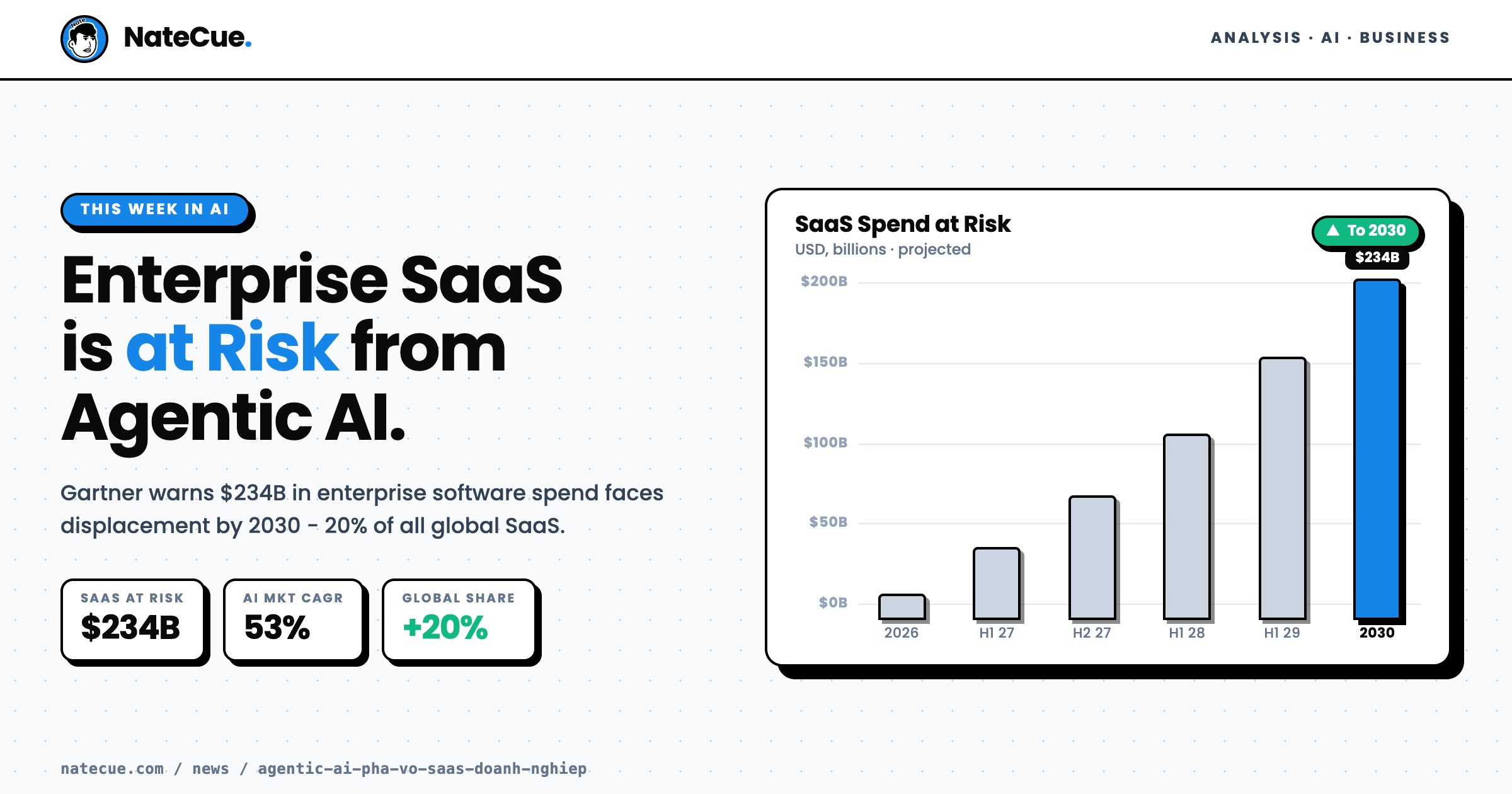
Gartner released the number on July 1, 2026: $234 billion in enterprise application software spending is at risk from agentic AI by 2030. That’s roughly 20% of all global enterprise SaaS spend. Not a distant projection. A structural shift already underway.

AI Agents Are Eating Software
The agentic AI market is growing at a 53% CAGR - from $8.5 billion in 2026 to a projected $45 billion by 2030. That pace outstrips every major enterprise software wave of the past two decades.
Deloitte estimates 35% of point-product SaaS tools will be replaced by AI agents or absorbed into larger platforms by 2030. These are the single-workflow tools that built the SaaS boom: task tracking, data entry, customer logging, form automation. Exactly what AI agents are best at.
Markets moved first. In early 2026, roughly $2 trillion in software sector market cap evaporated. Atlassian fell 35%. Salesforce dropped 28%. Their core workflows - task tracking, CRM logging, data entry - are exactly what AI agents automate best.
Gartner named the mechanism directly: “Agentic systems deliver outcomes directly, bypassing traditional UX-heavy applications and making the software invisible. This breaks the link between user growth and revenue growth for many enterprise software vendors.”
The Per-Seat Model Is Breaking
When one user equipped with AI agents can do what five seats used to handle, subscription pricing per head stops making economic sense.
IDC projects that by 2028, 70% of software vendors will restructure pricing around consumption or outcome metrics (CIO, 2026). Already, 83% of AI-native SaaS companies have moved to usage-based pricing (Deloitte, 2026). By 2030, Deloitte expects 40% of enterprise SaaS spend to shift to usage-based or outcome-based models.
This isn’t just a billing change - it’s a complete restructuring of how software is bought, valued, and renewed. For enterprise buyers, it’s negotiating leverage. For vendors, it’s an existential stress test: revenue becomes harder to forecast, sales compensation models need rebuilding, and churn risk spikes when outcomes fall short of expectations.
Which SaaS Survives - and Which Doesn’t
Not all enterprise software faces equal exposure.
Most at risk: Single-workflow point products - basic CRM, task management, data entry tools, form automation. The tools AI agents can be trained on fastest.
More defensible: Vertical SaaS with deep domain expertise - healthcare, legal, manufacturing. Regulatory complexity and deep data integration create natural moats.
Positioned to win: Major platforms like Microsoft, Oracle, SAP, and Salesforce. These companies are not losing ground to AI agents - they are becoming the infrastructure AI agents run on top of. Data moats matter enormously here.
Southeast Asia: Data Readiness Is the Real Problem
Nearly 90% of ASEAN enterprises plan to experiment with AI agents in 2026 (Salesforce). Salesforce Agentforce is already available in Vietnamese, Thai, and Bahasa. The adoption signal is clear.
But there is a wall most companies haven’t hit yet: only 26% of Chief Data Officers in the region believe their current data capabilities can support AI-driven revenue streams (CDO Trends, 2026). Eighty percent of CDOs are actively building datasets for AI agents - yet 79% admit they don’t know how to govern and scale them.
Southeast Asian enterprises, particularly in Vietnam, typically operate stacks of five to ten point-solution subscriptions. These are precisely the tools most exposed to agentic displacement. The question isn’t whether disruption is coming - it’s whether organizations have the data foundation to deploy agents effectively, or even to evaluate which subscriptions still make sense to keep.
The “SaaSpocalypse” hasn’t arrived in full force in Vietnam. But the preparation window is narrowing.
NateCue's Take
The real SaaS disruption story isn't about which tools die - it's a pricing model crisis. When one person with AI agents can do what five seats used to handle, per-seat licensing stops making economic sense. Enterprise buyers across Southeast Asia, including Vietnam, typically run stacks of five to ten point-solution subscriptions for CRM, project management, automation, and analytics. These are precisely the most exposed categories. But the smarter risk isn't vendor lock-in - it's data lock-in. 79% of CDOs in ASEAN admit they don't know how to govern AI agents yet. Confident agents running on messy data don't give you automation - they give you confidently wrong automation at scale.