
91% of all digital display ads are now transacted programmatically (SearchLab, 2026). But the underlying mechanism still works the same way it did in 2010: millisecond auctions, one impression at a time.
The Ad Context Protocol wants to change that.
What AdCP Actually Does
AdCP is an open-source communication protocol built on Anthropic’s Model Context Protocol (MCP). It gives AI agents across the advertising supply chain a shared technical language - standardizing how machines exchange structured data about audiences, inventory, and campaign objectives.
The founding coalition includes Yahoo, PubMatic, Scope3, Optable, Swivel, and Triton Digital, with supporting members AccuWeather, LG Ads, Raptive, Samba TV, and The Weather Company. The protocol launched October 2025 and is publicly available on GitHub, governed by AgenticAdvertising.org - an independent non-profit designed to prevent any single company from controlling its evolution.
The concept is simple enough to grasp through one use case: a brand prompts its agent with “Find women interested in rock climbing in the UK.” Publisher agents respond directly with matching inventory and audiences - negotiating on outcomes, not individual bids.
Scope3 describes AdCP as eliminating “the impossible choice between scale and strategic control” that has defined programmatic since its inception (Scope3, 2026). Digiday positioned it as “OpenRTB for the AI era” - a framing that puts it alongside the infrastructure that shaped programmatic for the past 15 years.
Early Numbers Worth Noting
Current programmatic operates at microsecond speed - pricing individual impressions in real time. AdCP enables something different: agents planning and optimizing across weeks or months, compounding intelligence across campaigns.
PubMatic ran a pilot campaign with AgenticOS and reported: 5.5x reduction in supply chain costs, 98% video completion rate, and 40% more impressions than originally planned (PubMatic, 2026).
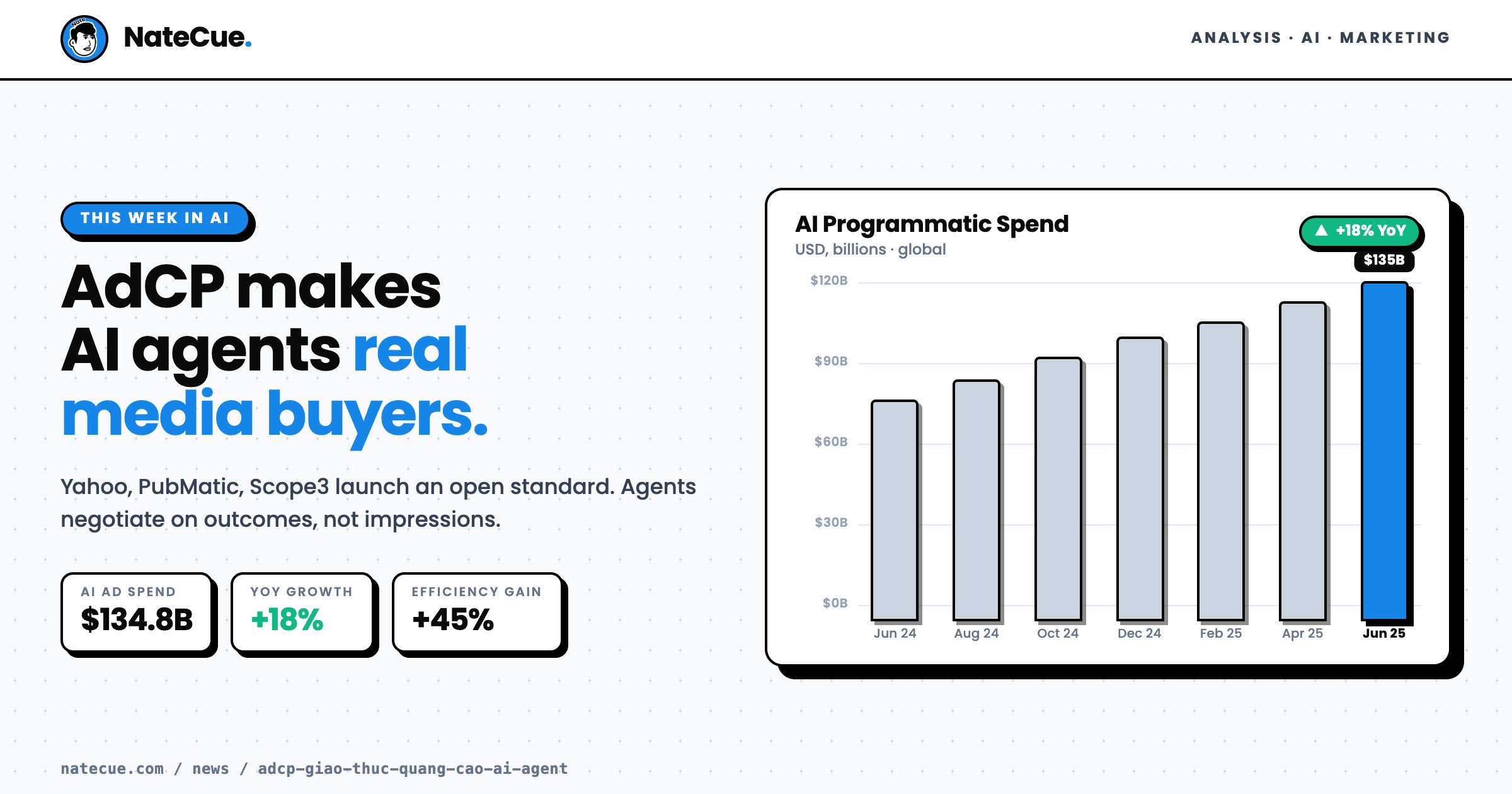
Broader market data confirms the direction. Advertisers adopting automation report 45% improvement in campaign efficiency and 38% reduction in manual buying effort (Basis, 2026). AI-driven programmatic spend hit $134.8 billion in 2025, up 18% year-over-year.
The governance structure matters. Unlike the walled gardens that dominate today’s programmatic landscape, AdCP is designed so no single company controls its direction.
Vietnam: The Late Mover That Can Skip a Generation
Vietnam’s digital ad market is projected to reach $5.39 billion in 2026, growing 9.1% annually (GlobeNewswire, 2026). By 2028, programmatic is expected to account for 78% of digital ad revenue.
That puts Vietnam mid-build on programmatic infrastructure - while the rest of the industry is moving to the next layer.
This creates a real opportunity. Markets like the US and UK are locked into OpenRTB stacks built over a decade. Vietnamese advertisers don’t have that legacy problem. When regional DSPs integrate AdCP - likely 2027 - local brands can adopt directly without the migration complexity that will slow down more mature markets.
CTV programmatic across Southeast Asia grew 43% in Q1 2025 versus 2023 - a signal that agentic inventory formats are scaling faster than expected across the region.
What’s Still Unproven
AdCP remains early-stage. Campaign components are being tested individually: planning, analytics, activation, troubleshooting. Large campaigns and creative still require human sign-off. PubMatic has set a target of solid documentation and practical demos within a year.
The real question isn’t whether AdCP will work technically. It’s whether enough publishers will integrate it to make agent-to-agent transactions meaningful at scale. A protocol without adoption is a whitepaper.
The harder question, which none of the sources address: when agents plan the media buy, who writes the brief they’re working from?
NateCue's Take
AdCP is not an automation tool. It's a protocol that redefines what a marketer actually does. When a brand's AI agent and a publisher's AI agent can negotiate directly, the marketer's job shifts: not setting campaigns, but setting goals and providing enough context for the agent to make the right calls - and knowing when to override. Vietnam is actually well-positioned here. The programmatic stack hasn't calcified the way it has in more mature markets. There's no legacy RTB infrastructure to migrate away from. When the first regional DSPs integrate AdCP in 2027, Vietnamese advertisers can adopt cleanly. The harder question nobody's asking: when agents write the media plan, who writes the brief they're working from? The best marketers in 18 months won't be the ones who know bid strategy. They'll be the ones who know how to brief an agent.