
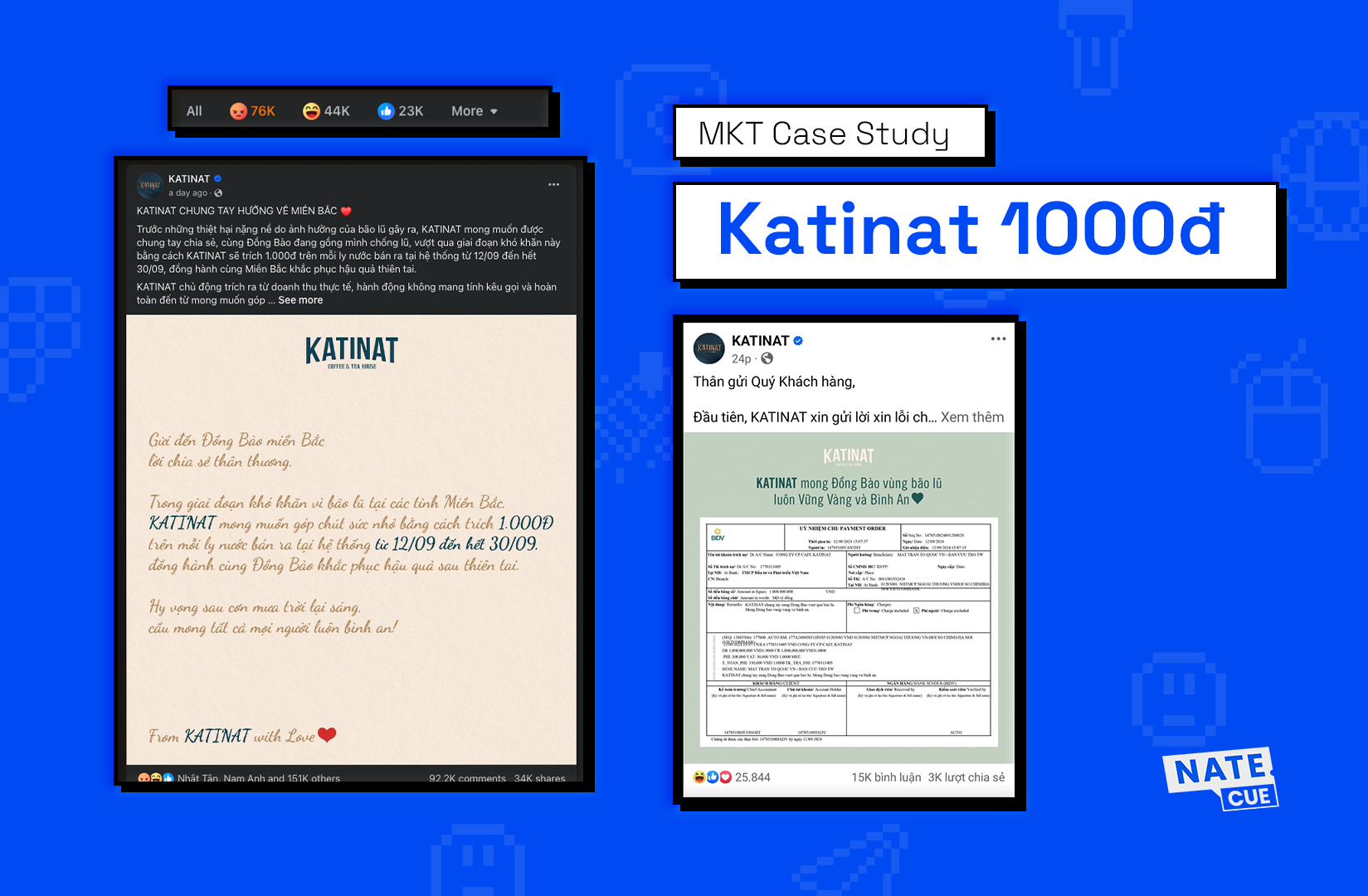
With the whole country rallying around northern Vietnam after Typhoon Yagi hit, Katinat launched a campaign pledging to donate 1,000 VND (Vietnamese dong) per drink sold to relief efforts. Instead of goodwill, they got a wave of angry reactions - the announcement post racked up an unusually high number of “angry” reacts on Facebook.
A few hours later, Katinat put out a new announcement committing to donate 1 billion VND directly to the Vietnam Fatherland Front (MTTQ), and that more or less put out the fire.
Analysis & Breakdown
This raises an interesting question worth discussing from a communications perspective: why did the exact same type of action - donating 1,000 VND per transaction - land so differently for Katinat versus Xanh SM (a Vietnamese ride-hailing and EV taxi service that ran a similar initiative)?

1. The Message Was Delivered Without Finesse
There’s one specific problem in Katinat’s announcement that I think is the root cause: the wording “1,000 VND per drink sold.”
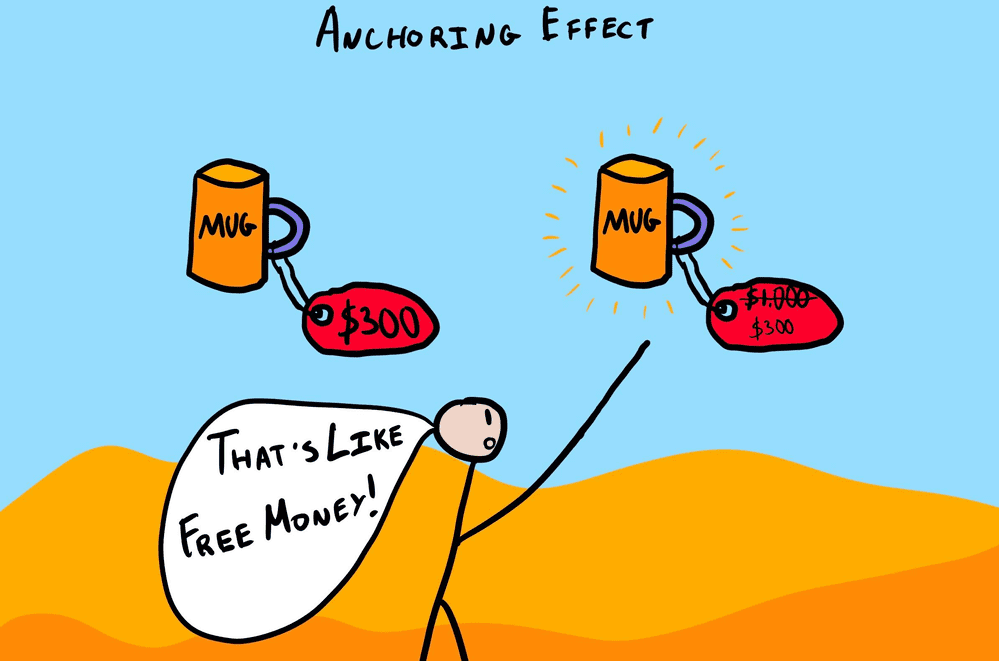
There’s a well-known psychological concept called anchoring bias - when you evaluate something, your brain automatically searches for a similar reference point to compare against. In this case, that reference point is the average price of a drink at Katinat, which runs around 50,000-60,000 VND. So people immediately compared 1,000 VND against that 50,000-60,000 VND baseline - and when the number looked that small, the emotional reaction was frustration instead of empathy.
On top of the wording issue, several other factors made things worse:
- The brand wasn’t putting in any of its own money - customers felt like Katinat was “exploiting” the disaster, using their money to buy the brand some good press
- The campaign was asking people to buy bubble tea, a non-essential purchase, during a national emergency
- The campaign would run until the end of the month before tallying up, while the country was scrambling urgently to respond to the crisis
- The primary channel was Facebook, which has high engagement but is also very susceptible to herd mentality effects
The reaction to Xanh SM’s similar campaign was far less negative, and here’s why:
(1) Safer wording: “1,000 VND from revenue” - no anchoring trigger, less emotional charge for users
(2) It’s an essential service - people were already going to spend money on a ride, so the donation felt like a natural add-on
(3) The communication channel was push notifications, which don’t carry the same high-interaction dynamics as Facebook, making the narrative easier to manage
If Katinat had used softer, more diplomatic language from the start - or committed the donation amount upfront and framed it as coming from revenue - things might have turned out very differently. I think the team actually had a target donation figure in mind from the beginning. The execution just didn’t match the intent.
2. It’s Not Just What You Give - It’s How You Give It
Contributing to flood relief is genuinely a good thing. But CSR (corporate social responsibility) communications require a certain level of delicacy. Once customers have already developed a negative impression of the brand (as described above), the entire campaign gets reinterpreted as an attention-grabbing sales tactic rather than a sincere act of generosity.
What Katinat Gained and Lost
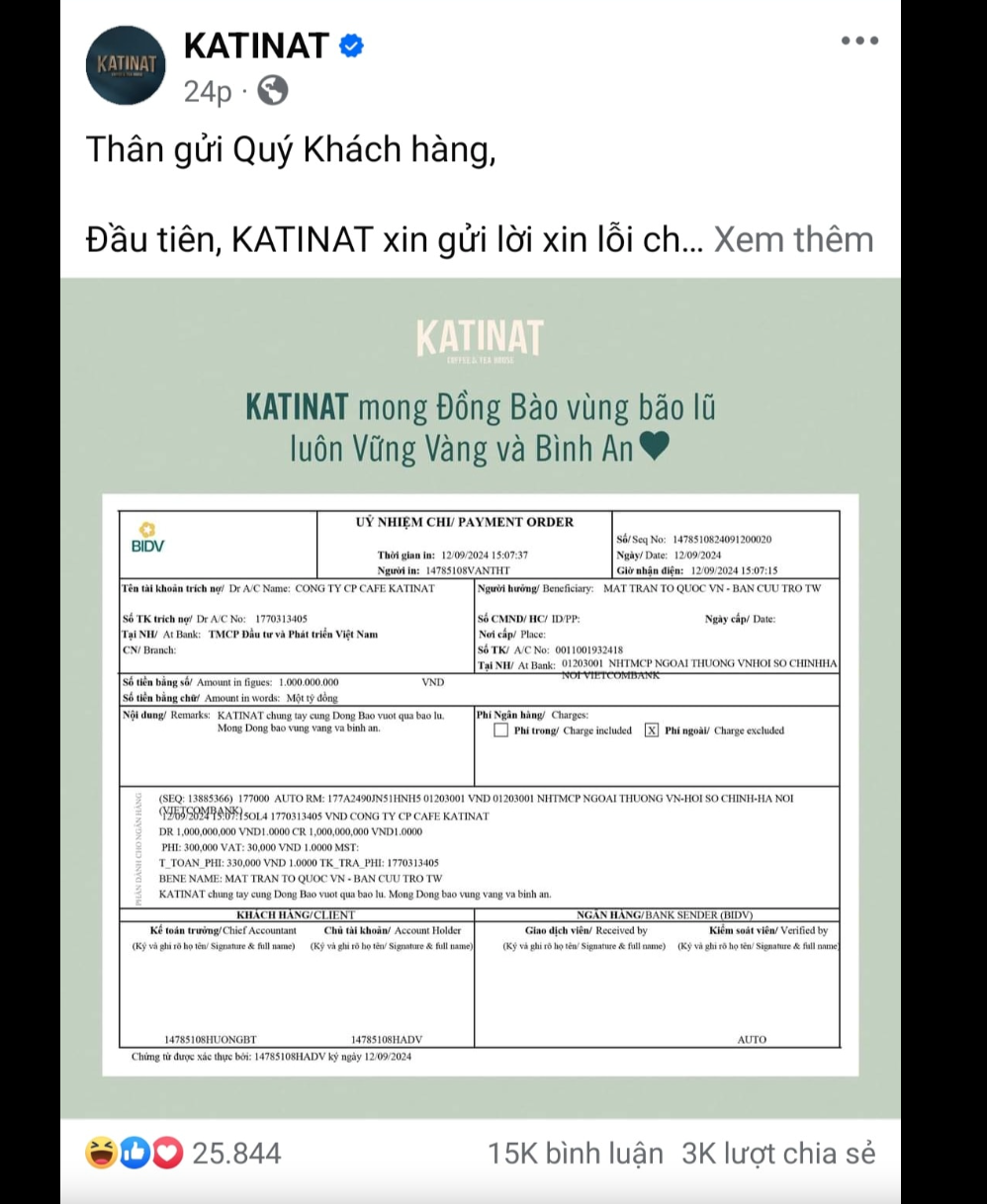
Once Katinat realized the situation was escalating, the team moved quickly - transferring 1 billion VND directly to the Vietnam Fatherland Front and publishing a clear public apology with supporting documentation. As a crisis communications response, this was textbook and well-timed.
Looking at the full picture: what Katinat “gained” was a massive spike in social engagement. In a sea of donation campaigns, everyone was suddenly talking about Katinat. But the cost is clear - brand love took a hit. At this point, just hearing the name “Katinat” immediately triggers the 1,000 VND incident for a lot of people. And having to mobilize 1 billion VND ahead of schedule would have had some real cash flow implications for the business too.
Wrap-up
As a commercial brand, the last thing you want is to be labeled as someone exploiting a national disaster for gain. Katinat is a well-established brand - they don’t need stunts or manufactured narratives to stay relevant. This situation cost them more than it gained. That said, credit where it’s due: the team followed through on what they promised. I hope the brand recovers from the reputational damage sooner rather than later.